Welcome to WordPress.com. This is your first post. Edit or delete it and start blogging!
Hello world!
1

Welcome to WordPress.com. This is your first post. Edit or delete it and start blogging!
Presentation given by Joi Ito at the 23rd Chaos Communications Congress on World of Warcraft.
Joi is an unfluential blogger and Entrepeneur, and also a guild leader of the Guild ‘’We know’’, which has many such people from the blogosphere and tech industry in it.
http://video.google.com/googleplayer.swf?docId=-5160442894955175707&hl=en
I thought it was very very good, also quite humorous to watch if you are a WoW player. The greater point he is trying to convey though is how MMO’s are increasinlgy becoming a proxy for real life, and a new social enviroment on a scale we haven’t seen yet much.
His comments about Teamspeak are very interesting, and I have been thinking about the same thing often. We as a guild have our own Teamspeak server, which I purchased, and a core group of people are always on it. Its an ambient channel of presence, and its very important to the guild to have this social tool, it enhanced the feeling of community, even though some people in the guild choose not to use it at all, except during raiding.
The argument that especially interpersonal and leadership skills are naturally developed in games like this is one I can very much identify with, being in the leadership of a guild myself.
I have probably learnt more about people and how to deal with them in the last year of playing WoW, than I ever have in my job or social life. You are simply exposed to more, more diverse people, in a dynamic, and totally free-range enviroment. Many of the restrictions to social contact in the real world simply dont exist in an MMO, and the context is totally different.
Ito als touches briefly on Machinima, the addon and interface customisation (and how its use parrallels our increasingly online activities), and he talks briefly about gold-farming and socio-economics. All in all its a great presentation, go have a look!
Presentation given by Joi Ito at the 23rd Chaos Communications Congress on World of Warcraft.
Joi is an unfluential blogger and Entrepeneur, and also a guild leader of the Guild ‘’We know’’, which has many such people from the blogosphere and tech industry in it.
I thought it was very very good, also quite humorous to watch if you are a WoW player. The greater point he is trying to convey though is how MMO’s are increasinlgy becoming a proxy for real life, and a new social enviroment on a scale we haven’t seen yet much.
His comments about Teamspeak are very interesting, and I have been thinking about the same thing often. We as a guild have our own Teamspeak server, which I purchased, and a core group of people are always on it. Its an ambient channel of presence, and its very important to the guild to have this social tool, it enhanced the feeling of community, even though some people in the guild choose not to use it at all, except during raiding.
The argument that especially interpersonal and leadership skills are naturally developed in games like this is one I can very much identify with, being in the leadership of a guild myself.
I have probably learnt more about people and how to deal with them in the last year of playing WoW, than I ever have in my job or social life. You are simply exposed to more, more diverse people, in a dynamic, and totally free-range enviroment. Many of the restrictions to social contact in the real world simply dont exist in an MMO, and the context is totally different.
Ito als touches briefly on Machinima, the addon and interface customisation (and how its use parrallels our increasingly online activities), and he talks briefly about gold-farming and socio-economics. All in all its a great presentation, go have a look!
Okie.. so I am totally bored at work, lets see what fun I can have with IBM Director and some spare servers lying around.
I thought it might be cool to try and make a rule that checked if a server had been turned off, and then brought it back up.
This would be usefull for us, as we cannot physically administer all the servers we are responsible for, and there are always overzealos ‘admins’ walking about in remote locations who have a tendency to sometimes turn off servers instread of just logging out.

Above you see 2 IBM xseries 306m servers on the bench. They both contain the PCI version of the IBM RSA-II remote management card.

This card gives you a nice web-based management interface for your server, even if its powered down. You can, for example, turn on the server from here, or monitor its vital statistics, and take control of the console.

You can also set up the RSA card to report to a central IBM Director management server. Here you see the server listed as a “physical platform”, and as you can see, it has been associated with the IBM Director Agent component running in windows.

We can do a lot of stuff with the object here, same as via the web interface, as much more, as you can see from the menu.

As you can see above, one of the things we can do from here is turn the power on and off remotely, as with the web interface.
We now have all the bits we need to build a solution.
We have an Alert source: The RSA-II card, and a management server to interpret the alerts, the IBM Director Server
We have an eventing engine that can bind the alert to some actions, and the IBM director server itself is capable of actually performing the actions too.
To start, we create a rule in the IBM Director Event Action Plan builder tool.

It consists of 2 components.. an event filter.. or ‘trigger’ as I like to call it, and then some actions to perform once the trigger is tripped.
In the IBM world, servers and software (such as agents) generate alerts using a bunch of different languages or protocols. You can read about some of them here.
The one we are looking for here is a so-called MPA Alert. Its sent out by hardware like the RSA card, or the xseries BMC (Baseboard Management Controller), or in our case by the RSA-II card.
We are gonna respond to the MPA.Component.Server.Power.Off event, here you see it occuring in the IBM director eventlog:

In our event action plan, we make a Threshold Filter that looks specifically for this event occuring.


We assign a 10 second timeout to the filter, and the Count field is set to 1, it only needs to occur once for the filter to trigger the actions.
Actions are pretty straitforward. We want the server in question to be turned back on when the event is triggered, and we want to recieve some kind of alert of this happening.
As you could see before, the IBM director server itself gives various power options for servers.

Luckily for us, when building events, the Event Action Plan Builder provides an interface to many of these controls for the Eventing engine to use

The last bit we need is a neato mail to be sent to us admins when this event is triggered.

So, now we can take our finished Event Action Plan, and apply it to some objects.

For this to work, you need to apply the Action Plan to the physical platform, not the Agent Object of the server.

Ok.. thats about it.
If all goes well, you will find you can no longer turn off the server, whahah. 😀 (unless you unplug the Ethernet of the RSA card of course). It will turn itself on every time within 10 seconds of being turned off. Talk about uptime! 
And to boot, you get a nice mail in your inbox:

This post discusses the Standard IBM Bladecenter Chassis, not the T -or H Chassis systems.
A common warning message you might recieve from an IBM Bladecenter is as follows:
“Demand exceeds a single power module. Throttling can occur in power domain 1.”
The message is normal.
In a normal rudundant situation, all power needs are drawn from both PSU’s, so you effectively have 2 x 2000 = 4000w for a single power domain during normal running. Its not a fail-over system, its drawns its power from both PSU’s at the same time. So its kinda like ‘load balencing’.
In a NON-redudant situation, so when you loose a single power domain, the bladecenter will only have 2000w left per power domain.
For 8 servers, its drawing more than 2000, as you saw, 2418 or therabouts.
With the power policy “Redundant with potential performance impact”, the bladecenter will attempt to clock-down some of the blades servers until the powerconsumption is below 2000w, so it can keep running.
The clocked down servers will of course suffer the “performance impact”.
In short: The Bladecenter you are using is not able to support all blades at full performance, IF you loose power redundancy.
Therefor, actually, these bladecenters can not be considdered “fully redundant” .
It may not suprise you that IBM, not its partners, do not like to easily admit to this limitation.
In the meantime, the warning remains, to remind you that this may happen when you loose redundancy.
There are 2 workarounds:
1. Redistribute your blade servers across both power domains evenly, so you dont use more than 2000 watt per power domain. If you place more servers this will be come unattainable though.
2. Make sure all 4 PSU’s are connected to a redundant power source, so backup power (with generator). This more or less circumvents the entire problem.
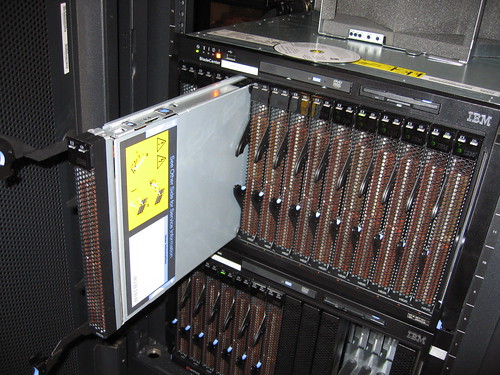
I was approached by a contributer of the Wikimedia group, if they could use some of the pictures I had uploaded of Bladecenters, for the official Wikipedia article on them.
I of course said it was oke, and now 3 of my pictures have become part of the Wikimedia archive as offical resources under the GNU FDL licence.
http://commons.wikimedia.org/wiki/Image:IBM_HS20_blade_server.jpg
http://commons.wikimedia.org/wiki/Image:Pile_of_IBM_HS20s.jpg
http://commons.wikimedia.org/wiki/Image:IBM_bladecenter_%28front%29.jpg
I was very very impressed with the way I was approached and this was handled.
They now seem to use ‘official’ standard emails for request of usage of pictures and other media, and the email exchange was very well and professionally handled.
Here is a copy paste of the original mail I recieved.
Hi Jeminus,
my name is G.P. and I’m writing to ask you a permission to include some of your blade server images in Wikipedia, the free encyclopedia you may browse at:
I think these three images would be a great addition to our blade server article:
http://www.flickr.com/photos/jemimus/66531212/
http://www.flickr.com/photos/jemimus/66530803/
http://www.flickr.com/photos/jemimus/74452762/
I have listed them in order of personal preference. As you might know, Wikipedia is a free encyclopedia that is collaboratively edited by volunteers from around the world.
Our goal is to create a comprehensive knowledge base that may be freely distributed and available at no charge.
Normally we ask permission for material to be used under the terms of the GNU Free Documentation License. This means that although you retain the copyright and authorship of your own work, you are granting permission for all others (not just Wikipedia) to use, copy, and share your materials freely — and even potentially use them commercially — so long as they do not try to claim the copyright themselves, nor prevent others from using or copying them freely.
You can read this license in full at:
http://en.wikipedia.org/wiki/Wikipedia:Text_of_the_GFDL
This license expressly protects creators from being considered responsible for modifications made by others, while ensuring that creators are credited for their work.
There is more information on our copyright policy at:
http://en.wikipedia.org/wiki/Wikipedia:Copyrights
We choose the GFDL because we consider it the best available tool for ensuring our encyclopedia can remain free for all to use, while providing credit to everyone who donates text and images. This may or may not be compatible with your goals in creating the materials available on your website. Please be assured that if permission is not granted, your materials will not be used at Wikipedia — we have a very strict policy against copyright violations.
With your permission, we will credit you for your work in the image’s permanent description page, noting that it is your work and is used with your permission, and we will provide a link back to your website.
We invite your collaboration in writing and editing articles on this subject and any others that might interest you. Please see the following article for more information.
http://en.wikipedia.org/wiki/Wikipedia:Welcome,_newcomers
Thank you for your time.
Kindly,
G.
I have recently have the urge to post maily about personal things.
I feel that geekswithblogs.net is not the place for these kind of posts. I share Jeff and John’s wish to make this site becomes an ever increasing valuable resource to the IT community. Purely personal posts may detract from that goal.
So therefore, I will from now on only be using my Geekswithblogs blog to post on technical matters, which is mostly IT Professional / Sysadmin related.
My personal posting can be found on the following pages, which are all mirrors of eachother:
http://jemimus.livejournal.com/
http://spaces.msn.com/jemimus/
If you even care 😉 , subscribe to my MSN Spaces RSS feed: http://spaces.msn.com/jemimus/feed.rss
And my homepage, as always: http://www.jemimus.net
I share a flat with a guy I have known since college.
He is a natural piano player, and plays more or less anything, but his favorite stuff is classical. That means that many evenings I have a live classical performance in the house, I probably don’t tell him enough how much I appreciate it 
Its given me quite a musical education, and when someone asks, I can say I listen to classical music a lot
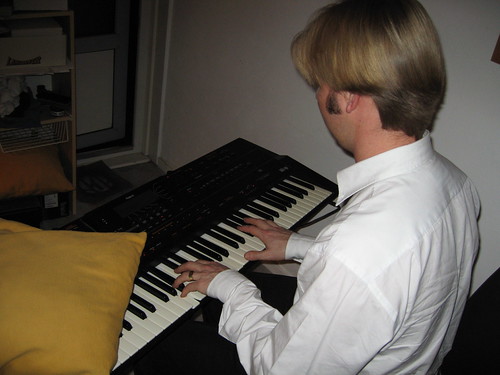
Here is a sample of his work, in this case a classical version of some music from episode 7 of the Pure Pwnage series. He really is very talented.
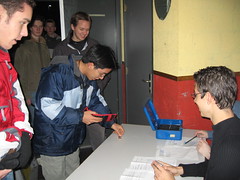
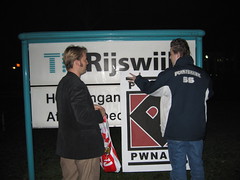
So last night was the advanced screening of Pure Pwnage Episode 9, organised by my m8 Skrie, who is quite well known on the Pure Pwnage forums.

About 50 people turned up, and some of the well known forum peeps stayed overnight. Several hundred people apparently turned up at the Toronto screening!
Overall it was a great success, and a testiment to how popular Pure Pwnage is becoming in the gaming community worldwide.







 The Fluffshack


